INSTITUTE FOR LEGAL NURSING & FORENSIC SCIENCE
Take 5 Minutes To Read Before Our Call
This page covers what legal forensic nursing is, what the work looks like in a real case, what nurses say about our Certified Legal Forensic Nurse (CLFN) program, and frequently asked questions.
What is a Certified Legal Forensic Nurse?
A CLFN works behind-the-scenes of legal cases reviewing medical records, analyzing timelines, and writing reports that attorneys rely on. Work-from-home. No scrubs. No patients. No hospital politics.
FROM NP TO BUSINESS OWNER
CAITLIN S.
AG-ACNP with a background in ICU and outpatient mental health. She wanted autonomy, a work-from-home lifestyle, and to be her own boss.
She used her NP clinical depth to build a legal forensic nursing practice on her own terms.
SHE ALMOST DIDN’T DO IT
WANDA P.
60 years old with 35 years of experience. Left high -stress executive role looking to reclaim work-life-balance and back to work she actually loved.
She proved it’s never too late to build something new.
DAY IN THE LIFE
How One Ordinary Shift Nearly Destroyed A Nurse’s Career
By the time this case landed on Jan Marie's desk, the damage was already in motion. A nurse who had spent years doing everything right was one meeting away from losing their license, their income, and their entire future.
Security footage showed the nurse entering an ICU medication room, removing fentanyl from a Pyxis machine, and appearing "flushed." That was enough. No syringe was ever found. No drugs were recovered. No patient was harmed. But none of that mattered to the people making the accusation.
What legal forensic nurses actually do
The job is not to guess. It is not to defend behavior. It is to reconstruct reality inside systems that were never designed to protect nurses.
How that facility's Pyxis actually logs access and how easily it is misread
What overrides mean in real emergency nursing
The disconnect between Pyxis and the EMR
Float culture between ER and ICU that non-nurses misunderstand
Surveillance footage that shows movement, not intent
Drug metabolism and detection windows
What evidence should have existed but did not
What the evidence actually showed
A Pyxis discrepancy is not diversion. It records access, not intent, not theft, not guilt.
No drug test was ever ordered, even though it would have answered the question instantly.
The medication was legitimately ordered. The issue was timing, assignment changes, and workflow confusion.
Video footage showed speculation, not proof. Even detectives admitted the evidence was indirect and weak.
QUICK FAQ
Questions Before Your Call
What exactly is this?
The CLFN program trains nurses to do behind-the-scenes, work-from-home med-legal work — the kind attorneys and insurance companies rely on when medical records and forensic analysis can change the outcome of a case. This is not SANE nursing. This is not traditional legal nurse consulting. It is a more specialized lane that blends forensics, legal nursing, and defense work into one practical training.
Can I do this while still working?
Yes. Most nurses complete the program while still employed. The program is self-paced with no deadlines. Many nurses start part-time per case, per project, evenings or weekends and grow from there.
How much can I make?
Our nurses commonly charge $150-$175 per hour. Those with specialty training can see up to $300 per hour in high-complexity situations. You will learn how to price, package, and build a profitable practice. All templates, contracts, and service tools are included.
How will I find clients?
You will not be handed a certification and be left to figure it out. The program includes done-for-you outreach scripts, templates, and follow-up sequences. During your first few cases, as long as you stay in the community, you are supported heavily. Zoom strategy support on your first reports is included so you are not winging it alone.
How do you evaluate competency without an exam?
Attorneys do not care about exams. They care about work product. Our nurses complete 3 real-world case evaluations before graduating by organizing real medical records, writing attorney-ready reports, and producing work that saves attorneys time. That leads to repeatable paid work, not just a certificate.
Is the program accredited?
Accreditation applies to colleges and universities that grant degrees. It does not apply to independent professional practice training programs like this one. There is no governing board for legal forensic nursing or legal nurse consulting. Every program in this space, without exception, creates its own standards. What sets the CLFN program apart is not a credential on paper. It is that you complete 3 real-world case evaluations before you graduate and leave with a portfolio attorneys can actually evaluate. The program is approved by the California Board of Registered Nursing, Provider #17837, for 47 continuing education credits and is ANCC'S Nationally Recognized Accreditation.
TESTIMONIALS
Life Beyond The Bedside
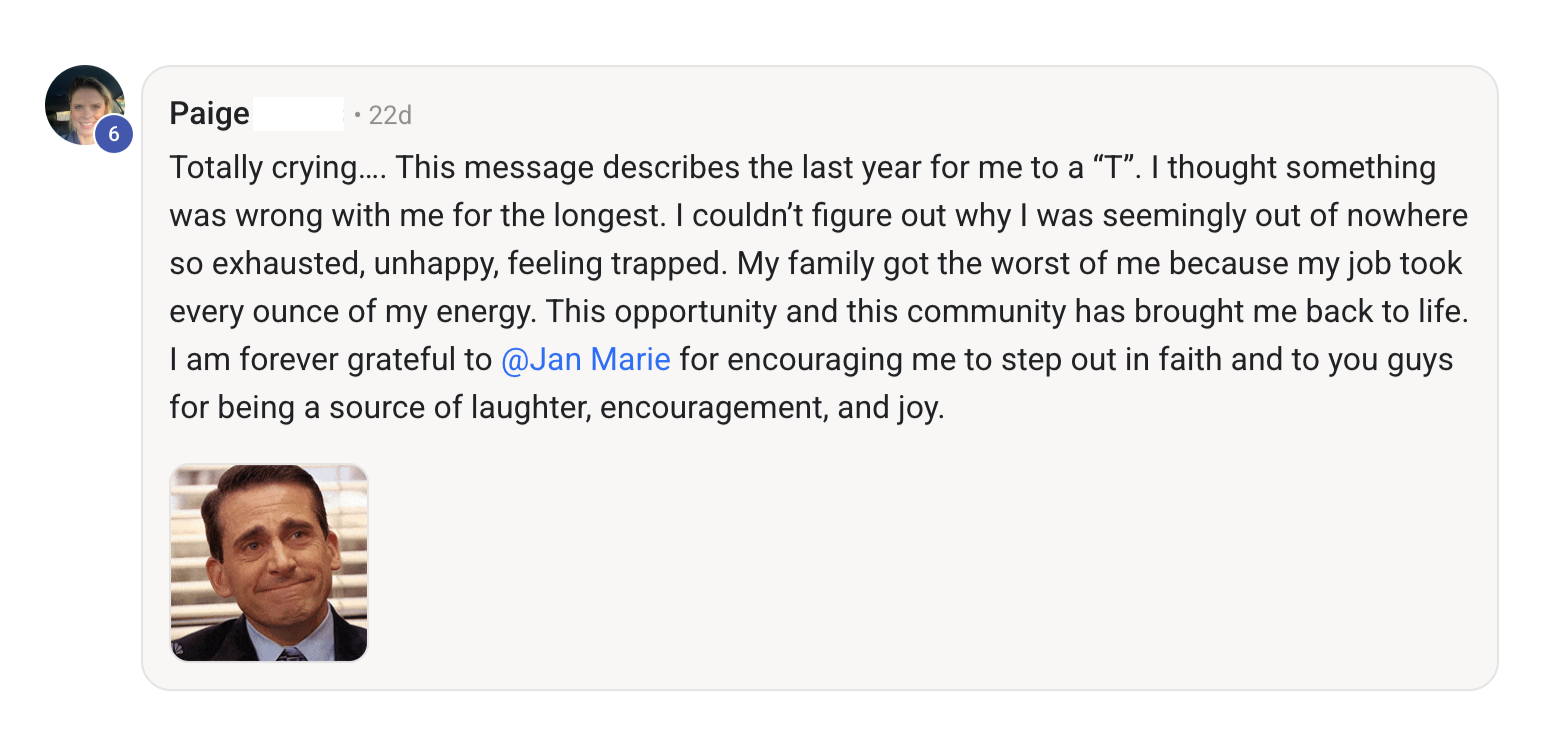
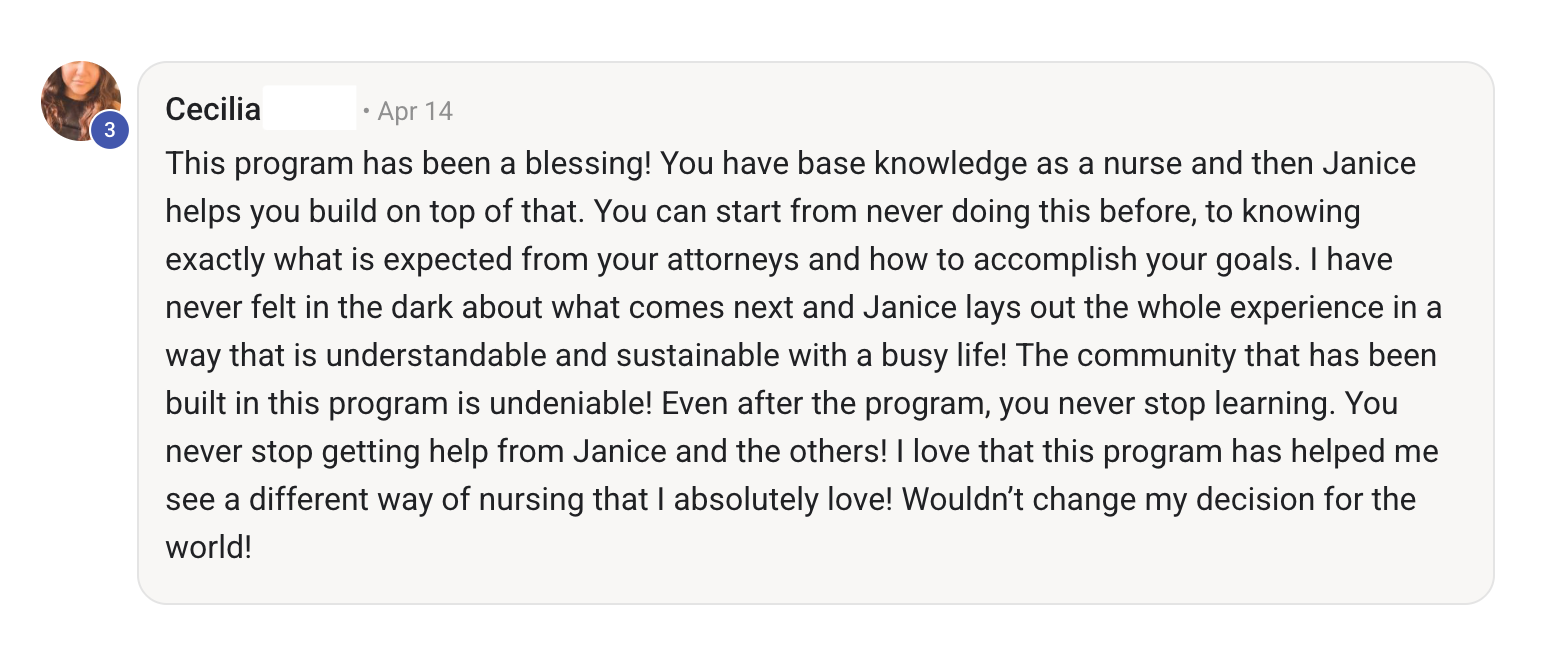
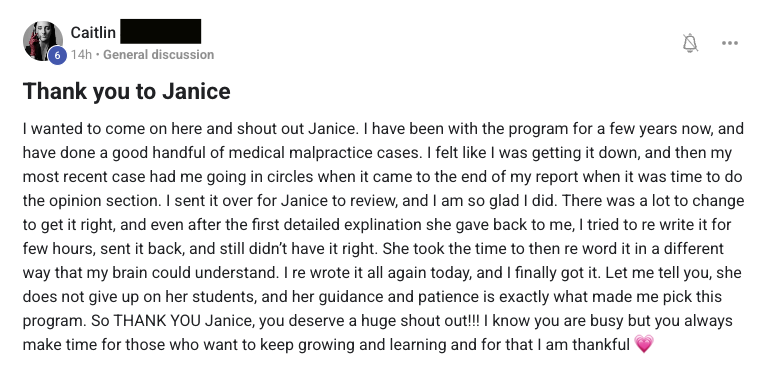
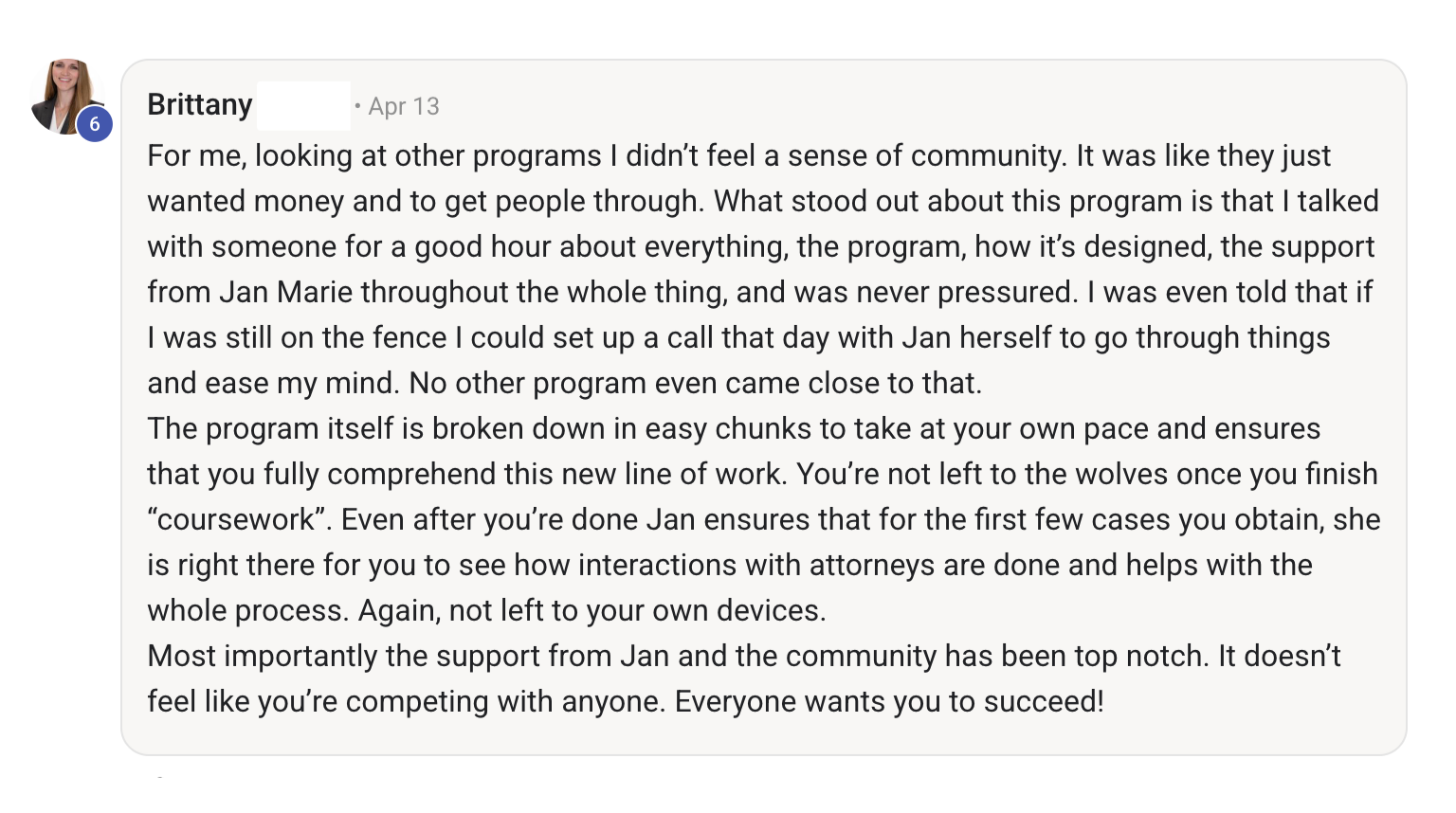
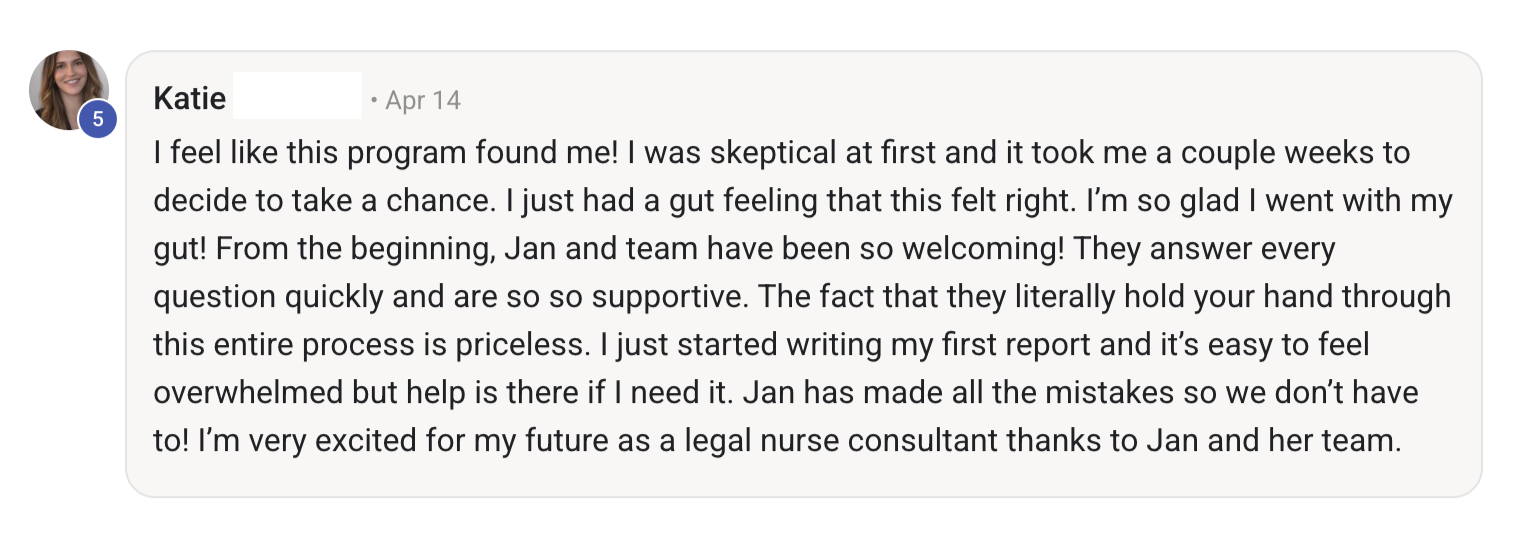
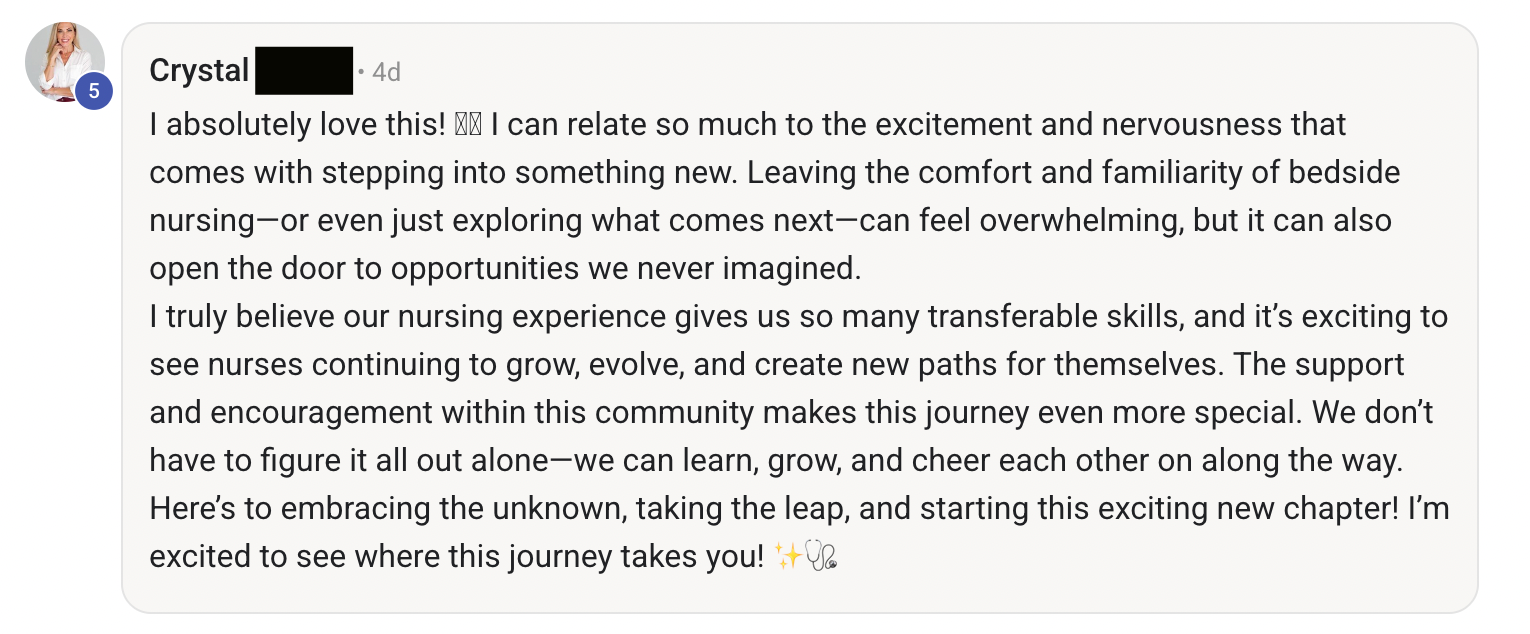
If you are still on the fence, you are not alone. Here is what nurses said after they made the decision.